

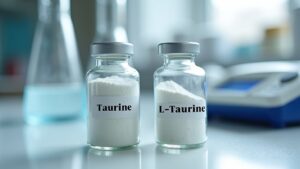
You may have seen “taurine” and “L-taurine” on supplement labels and pondered whether there’s a real difference—spoiler, there isn’t. Both terms describe the same amino-like compound that supports your heart, brain, and muscles, but confusion lingers because of how supplements are marketed. Regardless of it being energy drinks or recovery formulas, the benefits don’t change based on the label. So why does this myth persist, and what really matters at the time of picking a quality product? Let’s clear things up.
Understanding Taurine and L-Taurine: Chemical Structure and Naming
Because you could’ve seen “L-taurine” on a supplement label and questioned whether it’s different from regular taurine, here’s the truth: they’re the exact same thing.
The “L” in L-taurine is a misnomer—taurine doesn’t come in L or D forms like other amino acids. Its chemical structure is unique: a sulfur-containing compound with a sulfonic acid group, not built like typical protein-forming amino acids.
Taurine’s role in cellular functions and health benefits stays identical, whether labeled as L-taurine or plain taurine. You’ll find it in energy drinks and heart health supplements, but don’t stress over the name—your body processes them the same way.
The confusion stems from labeling habits, not science. Focus on its nutrients, not the prefix.
Biological Functions and Health Benefits of Taurine
Your body relies on taurine more than you might realize—it’s a multitasking molecule that keeps your heart strong, your brain sharp, and your muscles ready for action.
Taurine supports heart health by regulating calcium levels, ensuring your ticker beats steadily. It’s also a powerful antioxidant, shielding cells from oxidative stress that can lead to aging and disease.
For your central nervous system, taurine helps maintain focus and calm, while boosting energy at times you need it most. Should you be active, it improves exercise performance by reducing fatigue and speeding recovery.
Even your immune system gets a boost from taurine, helping you stay resilient. From brain function to muscle power, this amino acid quietly works behind the scenes to keep you feeling your best.
Common Myths and Misconceptions About Taurine Sources
Even though taurine pops up in energy drinks and supplements all the time, there’s a lot of confusion about where it actually comes from.
One big myth is that it’s extracted from bull bile or even bull sperm—thanks to its initial discovery in ox bile.
But modern taurine is synthesized in labs from other amino acids, making it plant-based and safe for vegetarians.
Another misconception is the term “L-Taurine,” which doesn’t exist—taurine doesn’t have L or D forms.
While energy drinks often spotlight taurine for its health benefits, rest assured it’s not animal-derived.
So, in case you’ve avoided it believing it’s not vegan-friendly, you can breathe easy.
The real magic lies in how your body uses this amino acid, not where it’s sourced.
Safety and Side Effects of Taurine Supplementation
Though taurine supplements are widely used, it’s smart to know how they could affect you. Most individuals tolerate taurine well, but side effects like nausea or headaches can occur, especially at high doses. Your body naturally makes taurine, but supplements can boost levels should you be low. Still, they may interact with medications, like blood thinners or statins, so consult your doctor initially.
| Potential Side Effects | Safe Dosage Range | At the Time to Be Cautious |
|---|---|---|
| Nausea, stomach pain | 500–3,000 mg/day | Taking other meds |
| Headaches | Up to 6,000 mg* | Liver conditions |
| Vomiting | Short-term use | Pregnancy/nursing |
| Liver discomfort | *For some studies | Kidney issues |
| Rare interactions | Varies by person | Unclear long-term |
Stick to recommended doses, and prioritize safety to enjoy the benefits of taurine without risks.
Choosing the Right Form: Taurine vs. L-Taurine for Optimal Health
Since taurine and L-taurine often pop up on supplement labels, it’s easy to be curious about whether there’s a real difference—but here’s the positive information: they’re the exact same thing.
The term “L-taurine” is misleading because this amino acid doesn’t have distinct forms like others. Your body naturally produces taurine, making it conditionally essential for heart health and other functions.
The L-taurine label is unnecessary—your body naturally makes taurine, a key player in supporting heart health and vital functions.
While selecting supplements, focus on quality over labels—both offer identical benefits. Look for trusted brands that prioritize purity and avoid unnecessary additives.
Whether it’s labeled taurine or L-taurine, you’re getting the same key ingredient that supports energy, brain function, and muscle recovery.
For ideal health, prioritize supplements with clear ingredient lists and third-party testing to guarantee you’re getting the best version of this powerful amino acid.
Conclusion
So now you know—taurine and L-taurine are the same thing, and that label won’t change how it works in your body. Fun fact: over 70% of energy drink consumers don’t realize taurine comes from natural sources like meat and fish, not synthetic labs. Whether you’re boosting workouts or supporting heart health, focus on quality, not the name. Pick what fits your needs, and trust the science behind this powerhouse nutrient.

